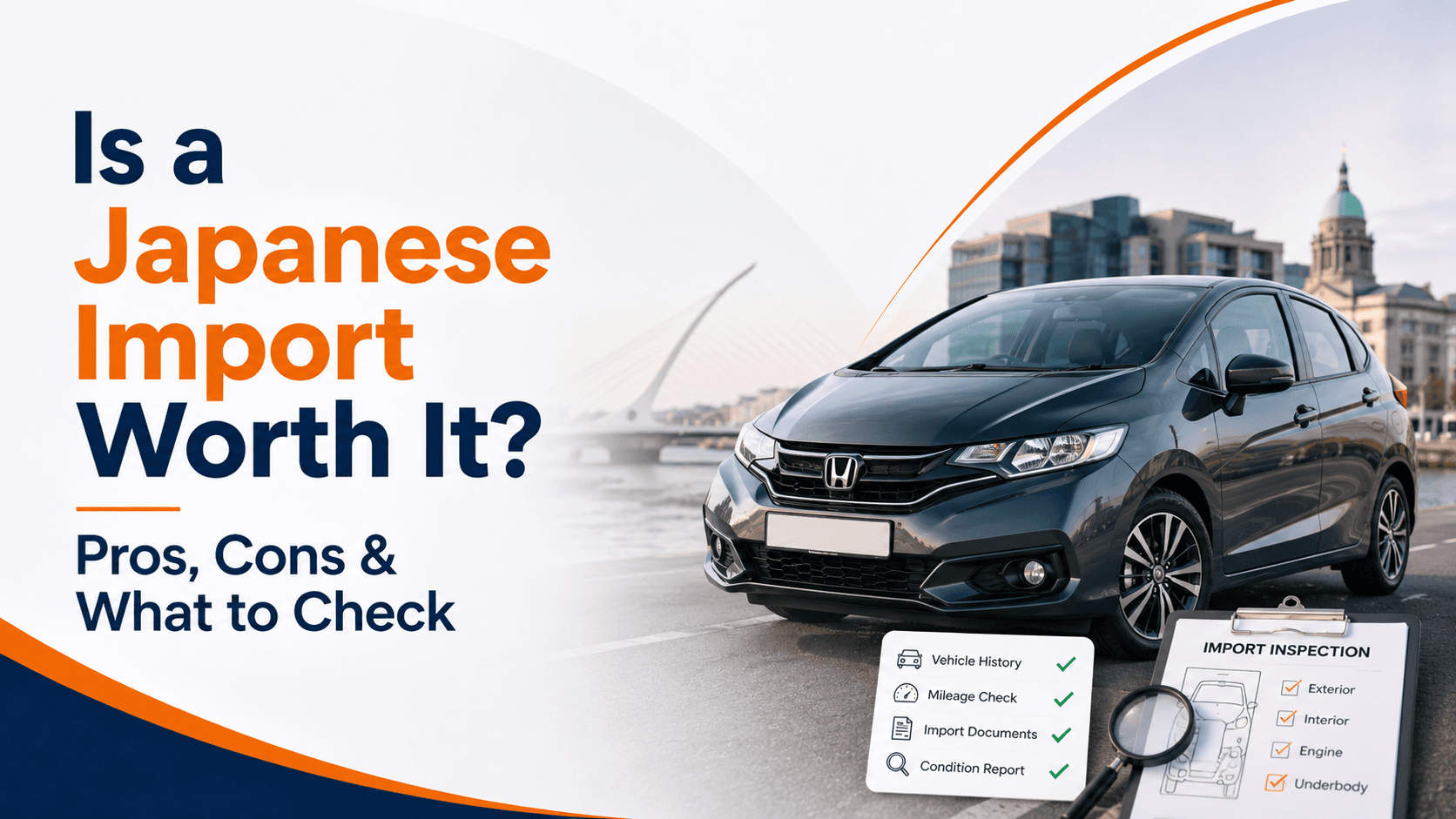
Walk around any Irish forecourt, including ours, and you'll spot them: Toyota Aquas, Honda Fits, Nissan Notes and Prius models that started life on the other side of the world. Japanese imports (often called JDM (Japanese Domestic Market) cars) have become a major part of the Irish used market, especially since Brexit made UK imports expensive.
So are they a smart buy or a gamble? Having imported and sold many of them ourselves, here's the honest picture.
Why Japanese imports landed in Ireland
Two things made Japan the go-to source. First, Brexit: VAT and customs duty on UK imports wiped out what used to be the cheapest supply of used cars. Second, Japan's Shaken system: a strict, expensive roadworthiness test that gets dearer as cars age, encourages Japanese owners to sell young. The result is a steady supply of low-mileage, well-maintained cars sold at auction and shipped worldwide.
Ireland is a natural destination: we drive on the left, so no conversion is needed.
The pros
More car for your money
The headline attraction. A Japanese import is typically a year or two newer, with significantly lower mileage, than the Irish-market equivalent at the same price. Japanese city driving patterns mean genuine low mileage is common, not suspicious.
Condition you can usually trust
Japanese auction houses grade every car (typically 1–5, plus interior/exterior scores) with a detailed inspection sheet. A grade 4 or 4.5 car has been independently assessed as excellent, a level of transparency the Irish private market simply doesn't offer. Combined with Japan's meticulous servicing culture and roads that aren't salted in winter, imports often arrive in better underbody condition than Irish cars of the same age.
Hybrid heaven
Japan adopted hybrids en masse years before Europe. Models like the Toyota Aqua and Prius, and Honda's hybrid Fit, are plentiful, cheap to run, kind on motor tax and proven over enormous mileages. For Dublin commuting, an imported hybrid is arguably the best value on the market.
Higher spec as standard
JDM cars frequently come loaded, climate control, keyless entry, cameras and parking sensors on trim levels that were basic in Europe.
The cons
The radio band problem
Japanese FM radio runs 76–90 MHz; Irish stations broadcast 87.5–108 MHz. Without a band expander (a €20–€50 fix) or a replacement head unit, you'll get almost no Irish stations. Factory sat-nav will also be Japan-only and effectively useless.
Japanese-language electronics
Infotainment, service menus and sometimes warning messages display in Japanese. Some systems can be converted or replaced; others can't. Check this before you buy, not after.
Parts and spec differences
Mechanical parts are rarely an issue for Toyota and Honda, most are shared globally. But JDM-specific trim, body panels or electronics can take longer to source. Some insurers also quote slightly higher premiums for imports, so get an insurance quote before committing.
History can be harder to verify
A car with no Irish or UK history relies on its auction sheet and export certificate. These are reliable documents, but only if they're genuine and you know how to read them. This is where buying from an experienced importer beats going it alone.
What it costs to import (and why buying one already here is easier)
Importing yourself means: the auction price, shipping (roughly €1,500–€2,500), customs duty (10%) and VAT (23%) on the landed value, VRT based on the car's Irish open-market value and CO2 band, plus the NOx levy, an NCT booking and Irish registration. It typically takes 8–12 weeks door to door, and mistakes on paperwork are expensive.
Buying an import that's already registered in Ireland skips all of that, the duty, VAT and VRT are paid, the car has Irish plates, and you can inspect and drive it before buying. That's how the imports on our forecourt are sold.
What to check on any Japanese import
- The auction sheet: ask for the original and a translation. Grade 4+ is what you want; grade R (repaired accident damage) needs a very good price to justify.
- Export certificate mileage: the official Japanese deregistration document records mileage; it should line up with the odometer and the auction sheet.
- Radio and electronics: confirm a band expander or new head unit is fitted, and test every screen and button.
- Underbody condition: usually a strong point, but verify it, especially if the car has now spent winters on Irish salted roads.
- VRT and registration status: if the car is on Irish plates, the hard work is done. If it's not, the VRT bill is yours; get a written estimate first.
- Insurance quote: confirm the exact model variant with your insurer before paying a deposit.
So, is a Japanese import worth it?
For most buyers, yes, provided the paperwork stands up. You're getting a newer, lower-mileage, often better-equipped car for the same money, and on proven models like the Aqua, Prius, Fit and Corolla-family hybrids the reliability record speaks for itself. The risks are almost entirely paperwork risks: auction sheets, mileage verification and VRT status. Buy from someone who has done the verifying, or learn to do it thoroughly yourself, and an import is one of the best-value moves on the Irish market.
If you're weighing an import against an Irish-market car, our guide to buying a used car in Dublin covers the checks that apply to every purchase.
Get car-buying tips in your inbox
Practical guides on finance, imports and finding the right used car in Ireland. No spam — just useful advice from our Dublin team.
Have your eye on a specific import, or want us to source one for you? Get in touch, we import directly and we're happy to talk you through the auction sheet on any car we sell.