Buying a used car without checking its history is like signing a contract you have not read. In Ireland, a clean-looking car can hide outstanding finance, a write-off record, clocked mileage, or a past life as a taxi or rental vehicle overseas.
The good news: a proper history check takes ten minutes and costs less than a tank of fuel. Here is exactly what to check, where to check it, and what the results mean.
Why a history check matters in Ireland
Ireland's used car market mixes Irish-market cars, UK imports, Japanese imports, and ex-fleet vehicles. Each has a different paper trail, and sellers do not always volunteer the full story.
A history check answers the questions that matter most:
- Is there outstanding finance on the car?
- Was it ever written off (Category A, B, C, or D)?
- Does the mileage add up across NCT records?
- Has it been imported, and from where?
- How many previous owners has it had?
Skip this step and you could buy a car the bank still owns, or one that fails its next NCT because of hidden damage.
Step 1: Run a Cartell or Motorcheck report
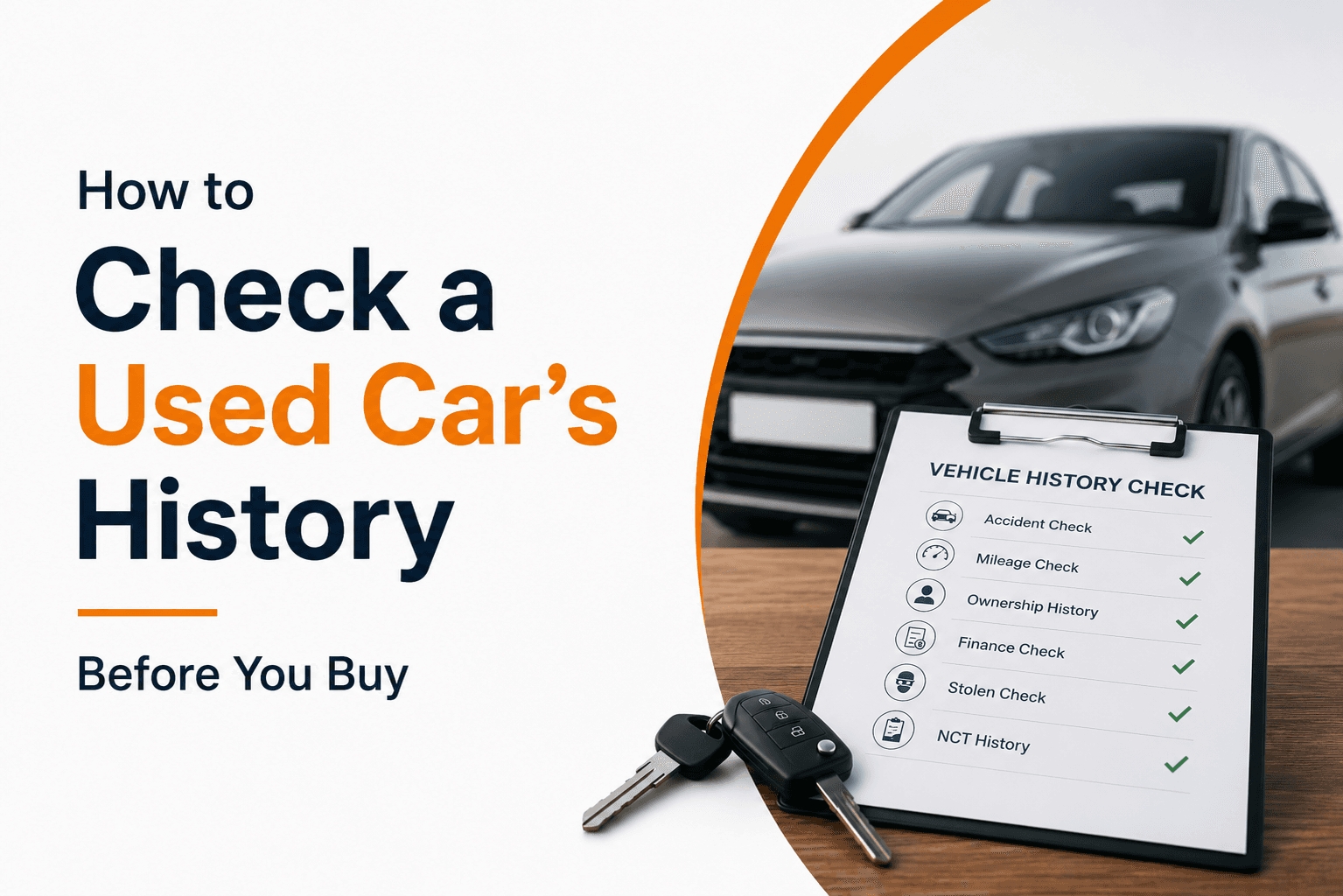
The two main vehicle history services in Ireland are Cartell.ie and Motorcheck.ie. Both charge roughly €35–€40 for a full report and take minutes to generate.
Enter the registration number and you get:
| Check | What it tells you |
|---|---|
| Finance check | Whether money is still owed to a lender |
| Write-off status | If the car was ever declared a total loss |
| Mileage history | Recorded odometer readings from NCT tests |
| Import status | Whether the car was imported and when registered |
| Previous owners | Number of registered keepers |
| Tax and NCT status | Current validity of both |
Both services are reliable. Cartell is widely used by dealers and insurers; Motorcheck offers similar depth. For a private sale, either is fine.
Step 2: Check the NCT mileage record
The NCT records odometer readings at every test. A Cartell or Motorcheck report includes this data, look for:
- Consistent increases: mileage should go up at each test, never down
- Large jumps: a car showing 80,000 km at one test and 45,000 km at the next has likely been clocked
- Gaps: missing NCT records on an older car can mean it was off the road or imported mid-life
You can also view basic NCT history free at ncts.ie using the registration number.
Step 3: Verify the logbook (VRC)
The Vehicle Registration Certificate, the logbook; must match the car in front of you:
- Registration number on the VRC matches the plates on the car
- Chassis number (VIN) on the VRC matches the stamp on the car (usually on the door pillar or under the bonnet)
- Registered owner name and address matches the person selling. If not, ask why (could be a family sale, or a disguised dealer)
- Colour and engine size match what you are viewing
A logbook that looks tampered with, or a seller who only has a photocopy, is a serious red flag.
Step 4: Check for outstanding finance
This is the most critical check. If a car has outstanding finance, the lender owns it until the loan is cleared, not the person selling it to you.
If you buy a car with outstanding finance and the seller stops paying, the finance company can repossess the car from you, even though you paid the seller in full.
Both Cartell and Motorcheck flag finance clearly. If finance shows as outstanding:
- Do not buy until you have written confirmation from the finance company that the loan is settled
- The settlement should happen before or simultaneously with your payment, not after
Step 5: Understand write-off categories
Irish write-off records use four categories:
| Category | Meaning | Buy it? |
|---|---|---|
| Cat A | Total loss; must be scrapped | Never |
| Cat B | Total loss, body scrapped, parts salvaged | Never |
| Cat C | Repairable write-off (pre-2017 UK system) | Only with full repair proof |
| Cat D / N | Minor damage write-off | Proceed with caution and a full inspection |
A Cat C or D car can be perfectly fine if repaired properly, but it will be worth less at resale and may be harder to insure. The seller must disclose this. If a history check shows a write-off and the seller did not mention it, end the conversation.
Step 6: Extra checks for imports
If the history check shows the car was imported, from the UK or Japan, dig deeper:
- UK imports: check for outstanding UK finance, flood damage history (especially post-2019), and right-hand drive compliance for Irish NCT
- Japanese imports: ask for the original auction sheet and export certificate; verify mileage against the Japanese deregistration document
Our guides to Japanese imports and buying a used car in Dublin cover import-specific checks in detail.
Step 7: Match the history to the car in front of you
A clean report does not replace a physical inspection. Cross-check:
- Service history: does the mileage in the service book match the history report?
- Wear and tear: does the condition match the recorded mileage? A 60,000 km car with a worn steering wheel and sagging seat may have been clocked
- Number of owners: a five-owner car in five years suggests problems; one or two owners is normal
What to do if something does not add up
| Finding | Action |
|---|---|
| Outstanding finance | Do not buy until cleared in writing |
| Write-off on record | Ask for repair invoices; get an independent inspection |
| Mileage discrepancy | Walk away, clocking is a criminal offence |
| More owners than expected | Ask why; check for recurring faults |
| Import not disclosed | Ask for full import paperwork |
If you are buying from a dealer and find an undisclosed issue after purchase, you have rights under the Consumer Rights Act 2022. Our guide to used car warranty in Ireland explains what you are covered for.
Get car-buying tips in your inbox
Practical guides on finance, imports and finding the right used car in Ireland. No spam — just useful advice from our Dublin team.
The bottom line
A €35 history check is the cheapest insurance you will buy in the entire car purchase process. Run Cartell or Motorcheck before every viewing, verify the logbook matches the car, and never pay a deposit until you are satisfied. Buying from a reputable dealer who history-checks every car, like our stock on the shop page, removes most of this risk from day one. Questions? Contact us.