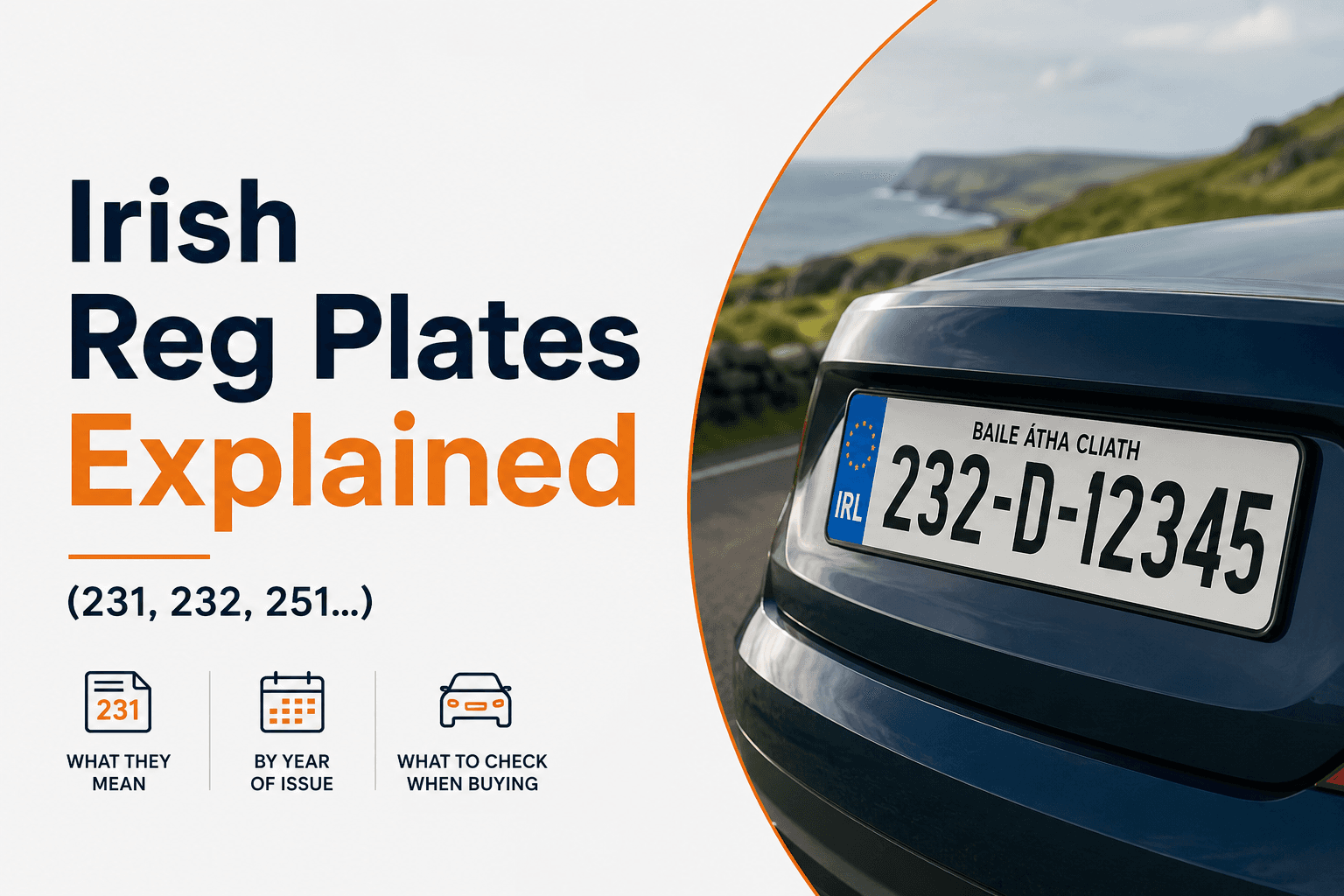
If you have ever wondered what the numbers on an Irish registration plate actually mean, why a 231 plate is from 2023, why Dublin cars say "D", and what happens when we run out of numbers in July, this guide explains the full system.
Understanding Irish reg plates helps you judge a car's age at a glance, spot mismatched plates on a used car, and avoid confusion when comparing vehicles online.
How the Irish registration system works
Since 1991, Irish number plates follow a standard format:
[YY] [County] [Sequence]
For example: 231 D 12345
| Part | Meaning | Example |
|---|---|---|
| YY | Half-year identifier | 231 = 2023, first half |
| County | County of first registration | D = Dublin |
| Sequence | Unique number within that period | 12345 |
The plate is issued when the car is first registered in Ireland, not when it was manufactured. An import registered in Ireland in 2024 gets a 241 or 242 plate even if it was built in 2020.
The half-year system: 1 and 2
Ireland registers cars in two periods each year:
| Plate prefix | Registration period | Example |
|---|---|---|
| 1 (e.g. 231, 241, 251) | January – June | 231 = Jan–Jun 2023 |
| 2 (e.g. 232, 242, 252) | July – December | 232 = Jul–Dec 2023 |
So a 232 plate is newer than a 231 plate from the same year, but both are 2023 registrations.
The first two digits encode the year:
- 23 = 2023
- 24 = 2024
- 25 = 2025
- 26 = 2026
County codes: where was it registered?
The single or double letter after the year code identifies the county of first registration:
| Code | County | Code | County |
|---|---|---|---|
| D | Dublin | G | Galway |
| C | Cork | L | Limerick |
| W | Waterford | KE | Kildare |
| WW | Wicklow | MH | Meath |
| WX | Wexford | OY | Offaly |
| CN | Cavan | MN | Monaghan |
| SO | Sligo | DL | Donegal |
| LS | Laois | KK | Kilkenny |
| T | Tipperary | CE | Clare |
| RN | Roscommon | LD | Longford |
| WH | Westmeath | MO | Mayo |
| KY | Kerry | LK | Limerick (city) |
Most used cars in the Dublin area carry a D plate, but a Dublin-resident car is not required to keep its original county code. The code reflects where it was first registered, not where it currently lives.
Reading plates from older systems (pre-1991)
Cars registered before 1991 use a different system based on year and county, with numbers resetting annually. You will see plates like 89 D 45678 (1989 Dublin) on older classics and some high-mileage workhorses still on Irish roads.
For used car buyers, pre-1991 cars are increasingly rare in the mainstream market. If you are looking at one, factor in NCT every year (not every two years) and higher motor tax on engine size, see our motor tax guide.
What about import plates?
When a car is imported and registered in Ireland for the first time, it receives a plate based on the date of Irish registration, not the date of original manufacture abroad.
Examples:
- A 2020 Japanese Toyota registered in Ireland in July 2024 gets a 242 plate
- A 2019 UK car registered in Ireland in January 2025 gets a 251 plate
This catches buyers out: a "2020 car" with a 242 plate is a 2024 Irish registration, and the car may have spent four years on Japanese or UK roads before arriving here. Always check the original registration date on the VRC logbook, not just the plate.
Our Japanese import guide and history check guide explain how to verify a car's true age.
Plates and NCT, motor tax, and insurance
The registration plate ties into several other systems:
- NCT due date: calculated from the date of first registration in Ireland (shown on the VRC), not the plate number alone
- Motor tax: based on CO2 emissions (post-2008) or engine size (pre-2008), not the plate
- Insurance quote: insurers use the registration to pull vehicle details; an incorrect plate on the quote will give wrong results
When getting an insurance quote, always use the exact registration number from the logbook.
Spotting plate problems when buying used
Watch for these red flags:
- Plate does not match the VRC: the number on the car must exactly match the logbook
- New plate on an old car: a 2015 car wearing a 252 plate has been re-registered (usually an import); verify why
- Private plates (dateless): legal in Ireland but can hide a car's true age; always check the VRC for the original registration date
- Missing or damaged plates: required by law; missing plates fail NCT
251, 252, 261: what is coming next?
Ireland issues new plate series twice a year:
| Plate | Period |
|---|---|
| 251 | Jan – Jun 2025 |
| 252 | Jul – Dec 2025 |
| 261 | Jan – Jun 2026 |
| 262 | Jul – Dec 2026 |
When browsing used cars online, the plate gives you an instant age reference, but always cross-check against the VRC for imports and private plates.
Get car-buying tips in your inbox
Practical guides on finance, imports and finding the right used car in Ireland. No spam — just useful advice from our Dublin team.
The bottom line
Irish reg plates encode the year and county of first registration in a simple system: first two digits = year, third digit = half-year (1 or 2), letters = county. Use plates as a quick age guide when browsing, but always verify the full history on the logbook, especially for imports. See our used car buying guide for the full pre-purchase checklist, or browse cars in stock at Hadi Motors.